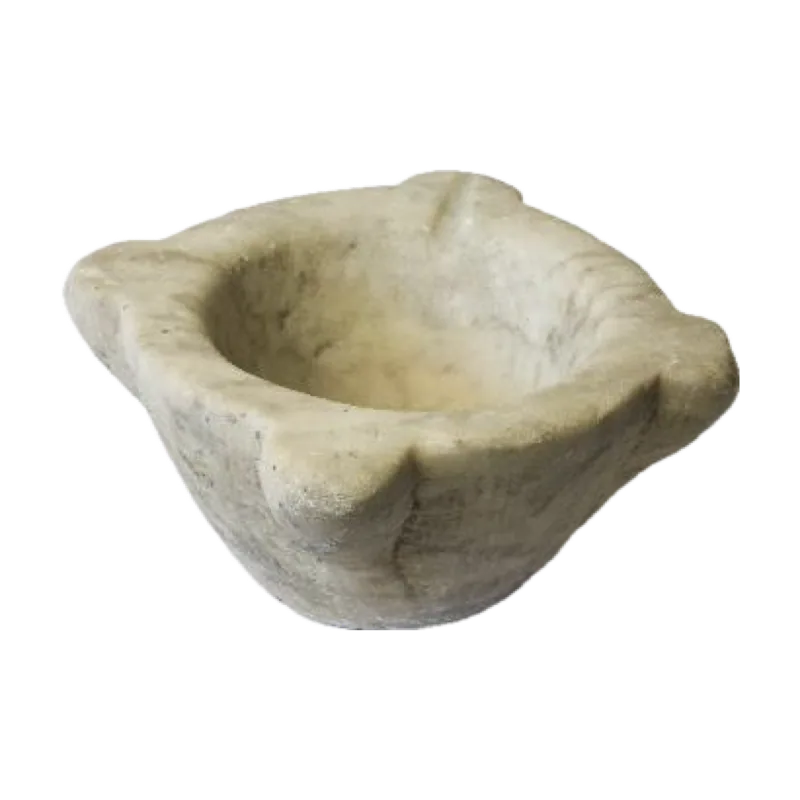
What is
Thick-walled glass where garlic, spices, salt, nuts, sauces are crushed and mixed. In Mallorca the pestle is called maça (DCVB: "he who s'empra per a esclafar coses contingudes dins un morter", with an example from the Capbrevacions of Mallorca of 1594). It is still in every kitchen: it is the tool for allioli.
How is
- Morter: glass with a hemispherical cavity and thick walls, made of stone, wood, glazed clay or metal. Sometimes with one or four semi-cylindrical pouring spouts (Viquipèdia).
- Maça: elongated piece, thicker at one end, almost always made of wood.
- Materials documented on the island: clay (appears in the Coll Conesa 2020 catalog of popular Mallorcan ceramics), olive wood (turned; see trade) and stone (types of Mallorcan stone to be verified).
- Measurements: there is no standard; to verify with museum pieces.
How is fa
- Olive tree: the turner roughs out the dry trunk, turns it and empties it; the maça, also on the lathe. Slow drying so that it does not crack ( fusta-d-olivera ).
- Clay: turned and glazed in a pottery (see torn-de-gerrer ).
- Stone: carved by a stonecutter (to verify production in Mallorca).
Com s'usa
- Allioli: crushed garlic and salt and oil added drop by drop, always turning the maça in the same direction (general recipe; local nuances to be verified).
- Chopped for stews, spices, almonds.
- The wooden one is not washed with strong soap so that it does not take on a flavor (common use, please verify).
Vocabulary
- morter: mortar.
- maça: pestle (DCVB; in Ibiza, pot).
- morteret / morteró: morterito (DCVB).
- allioli: garlic and oil sauce mounted in the mortar.
- ara que ets morter, para; quan seràs maça, ja picaràs: saying: the apprentice endures, he will command (DCVB, Men.).
- en esser maça, ja picaràs: same idea, to those who want to command without authority (DCVB, Mall.).
History
- 1069: "morter one" in a document cited by the DCVB.
- 1410: inventory with “un morter de coure ab sa mà de coure” and “dos mortés de pedra marbre” (Alòs, DCVB).
- 1414: «un morter de terra, item dos mortés de fust» (DCVB): clay and wood coexist.
- 1594: “un morter de coure ab sa masse”, Capbrevacions de Mallorca (DCVB, sv maça).
- Today: turned olive mortars are sold as kitchen pieces and souvenirs.
On veure'n
- Museum of Mallorca, Etnològica Section (Wall) : recreated kitchen.
- Fang Museum (Sa Cabaneta) and Pòrtol olleries.
- Olive workshops: BFC Art Olivera (Consell) , Eugenio Olivera (Sóller) .
Why is it design
- Two pieces, one function: glass and hand, without mechanism.
- Useful mass: the thick walls absorb the shock and fix the glass to the table.
- Local material: olive wood from prunings or dead trees.
- Lasts a lifetime: it does not break or need replacement.
For the project
- Piece: redesigned olive or clay morter (stability, spout, ergonomic pestle) with a turner and a pot.
- Activity: allioli workshop at the Fira del Fang with Pòrtol and olive mortars.
- Trades: fusta-d-olivera · turners · ceramics-i-gerreria . Files: greixonera , foganya-i-estris-del-foc .
Frequently asked questions
What is Morter (mortar) and maça?
Thick-walled glass where garlic, spices, salt, nuts, sauces are crushed and mixed. In Mallorca the pestle is called maça (DCVB: "he who s'empra per a…
What are the traditional words for Morter (mortar) and maça?
Some words: allioli, ara que ets morter, para; quan seràs maça, ja picaràs, en esser maça, ja picaràs, maça, morter, morteret / morteró.
Sources
- dcvb.iec.cat/results.asp?Word=morter
- dcvb.iec.cat/results.asp?Word=maça
- ca.wikipedia.org/wiki/Morter
- contents.idi.es/images/documents/Catalogo_XII_Jornadas_Baleares_20.pdf
Working text from the Disseny Indígena knowledge base, machine-translated from Spanish.